
| Rule | Meaning |
|---|---|
| Objective | Finish nearer 21 than the dealer without busting |
| Ace | Counts as 1 or 11; a soft total uses 11 |
| Actions | Hit, stand; double or split only under the table rules |
| Natural payout | Read the variant: 3:2 and 6:5 differ |
Card values and the objective
Cards numbered 2 to 10 are worth their printed number. Jacks, queens and kings are worth 10 each. An ace can be 1 or 11: use whichever value keeps the hand at 21 or below if possible. Suits do not affect a standard blackjack total.
A hand with an ace counted as 11 is called soft. Ace plus 6 is soft 17; drawing a 9 changes the ace to 1, making 16 rather than 26. A hard hand has no ace available to count as 11 without busting. Ten plus 7 is hard 17. Knowing whether a total is soft helps you understand both your choices and the dealer rule.
You are comparing your hand with the dealer, not with another player at the table. Another player’s result does not settle yours. If your total goes over 21, you bust and ordinarily lose that hand immediately, even if the dealer later busts too.
How a round unfolds
A standard round begins with a stake and two cards for each player. The dealer’s visible card is the upcard. Depending on the variant, the dealer may also receive a face-down card at the start, or take a second card later. That difference matters for when a dealer blackjack is discovered and how additional stakes are treated.
Players act in turn. The interface or dealer offers the choices permitted by the table. Once the players finish, the dealer reveals or receives the remaining card and draws according to the rules. Commonly the dealer draws below 17 and stops at 17 or above, but some tables require a draw on soft 17. The dealer does not choose freely between hit and stand as a player does.
Settlement compares each surviving player total with the dealer’s. A higher total ordinarily wins, a lower one loses, and equal totals ordinarily push, returning the stake. A dealer bust ordinarily pays surviving hands. Naturals and special variants can have separate settlement rules.
Hit and stand
Hit means request another card. You can usually hit again while the hand remains eligible, but a new card might take the total over 21. Stand means take no more cards and finish with the present total. It does not mean the hand has won: the dealer still has to complete the round.
For example, 10 plus 6 makes hard 16. A hit with 4 gives 20; a hit with 8 gives 24 and busts. Those are two possible outcomes, not evidence that one card is due. The decision happens before the next card is known.
Double and split
Double down normally adds a stake equal to the original stake and gives exactly one further card before the hand stands. Some tables restrict doubling to certain totals, allow a smaller additional amount, or permit it after a split. Doubling therefore changes both the money committed and the number of remaining decisions.
Splitting turns an eligible pair into two hands, usually with another stake equal to the original. One card begins each new hand and further cards are dealt under the split rules. Whether different ten-valued cards can be split, how many hands are allowed, and whether aces receive only one additional card all vary. A split is not free: it creates another stake exposed to the round’s outcome.
Natural blackjack and ordinary 21
An ace with a ten-valued card in the first two cards is a natural blackjack. A three-card total of 21 is ordinarily a regular 21, not a natural. Ace plus a ten after splitting is often treated as regular 21 too. The table decides these distinctions.
Natural blackjack payouts vary. A table paying 3:2 returns RM15 profit on an illustrative RM10 winning natural, plus the original RM10 stake. At 6:5 the profit would be RM12 on that same stake. Neither rate is a promise about a table on this website. A dealer natural, a simultaneous natural and an ordinary dealer 21 have to be settled according to the exact rules.
A worked hand, without a prediction
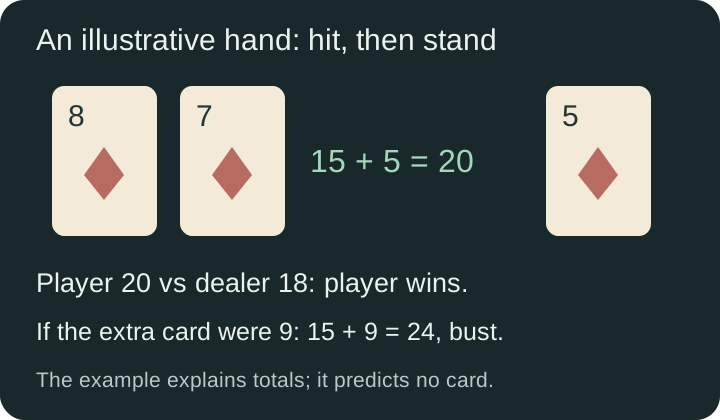
Suppose your first cards are 8 and 7, giving hard 15. You hit and receive 5, making 20, then stand. The dealer finishes at 18, so your 20 wins under ordinary comparison rules. Had your extra card been 9, your hand would have busted at 24 before the dealer finished. The example teaches addition and sequence; it does not prescribe a strategy or forecast a card.
Now compare ace plus 7. That is soft 18. A 9 would leave a total of 17 because the ace becomes 1. The same extra card has a different effect on a hard total. Practising those totals with ordinary cards, without stakes, is a useful way to learn the terminology.
Rules that deserve attention
Before using a table, find its natural payout, dealer soft-17 rule, doubling and splitting limits, and treatment of the dealer’s second card. Insurance is a separate bet associated with the dealer showing an ace; it is not protection that makes the main hand safe. Surrender, where available, has its own timing and cost. Side bets use separate paytables and can lose even when the main hand wins.
No drawing system removes uncertainty or guarantees profit. Optional actions can increase the total stake during a hand. If a rule is unclear, leaving the round or learning the variant without stakes is preferable to discovering its meaning after money is committed.
At a glance
- Aces can change between 11 and 1; recalculate the whole hand.
- Double and split can create additional stakes.
- A natural and an ordinary 21 are different hands.
Questions about this topic
Can a hand have more than one ace?
Yes. Two aces begin as 12, counting one as 11 and one as 1. Further cards can change both to 1.
Is blackjack the same as reaching 21?
No. A natural is ordinarily an ace and a ten-valued card dealt as the first two cards. Other totals of 21 are usually settled as ordinary hands.
Does a previous losing hand improve the next result?
It does not establish what the next hand will contain. These rules explain the game, not a recovery system.