
Method summary
DuitNow
Transfer / QRCheck the recipient name, amount and original bank reference.
Transfer by an identifier
With DuitNow Transfer, a recipient can link an identifier to an account at a participating institution. Common identifiers include a mobile number, MyKad or passport number, and a business registration number. This is sometimes called a proxy: it helps the payment system find the destination account without the sender typing its full account number.
A registered identifier is not the same as a contact saved on your phone. You still review the recipient name returned by the bank before authorising. If a number belongs to the wrong person or the name is unfamiliar, resolve that mismatch first. The destination is determined by the current registration, not the nickname in your address book.
What a QR code does
DuitNow QR lets a participating bank or wallet app scan a payment code. A static code generally identifies the recipient and may require you to enter the amount. A dynamic code can include an amount or payment-specific details. The app shows the relevant recipient and amount before approval. Scanning begins the journey; it is not the same as completing a payment.
Use your own trusted bank or wallet application rather than a link that asks you to install an unfamiliar payment app. A code pasted over a displayed code could direct money elsewhere. The recipient screen matters even when the printed sign looks familiar. No payment-network logo alone confirms the identity of a person requesting money.
Information to review before approval
A practical confirmation screen tells you who will receive the payment, how much is being sent, and which account or wallet will fund it. A transaction description or reference may also be available. If you are paying for something that has an order number, its recipient instructions should explain which reference identifies that order.
Imagine an illustrative RM50 transfer. The amount on your approval screen should be RM50 in the intended currency, and the returned recipient should match the intended payee. A correct amount sent to a different name is still a mismatch. A correct recipient with an incorrect order reference may require separate matching by the recipient. Neither situation is solved by repeating the payment immediately.
Approval, bank status and recipient records
Authentication happens through your bank or wallet, using the approval method it presents. Read the purpose and amount in the prompt. A request to reveal a one-time code in a chat is not the same as approving a payment inside your own banking app.
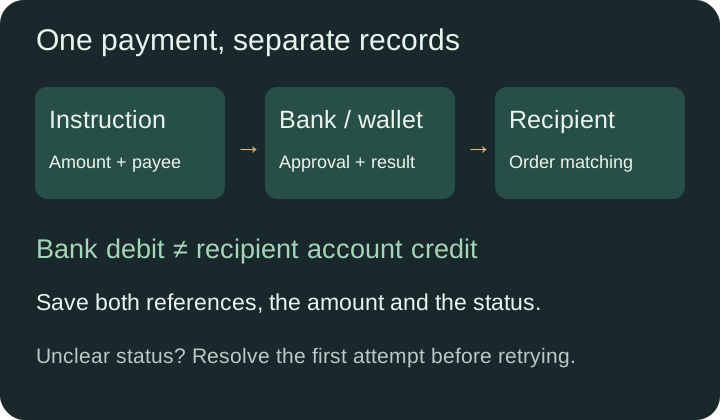
After approval, the app displays a result and normally offers a reference or receipt. A completed bank transfer and a credit recorded in a separate service account are different records. The network may have completed the money movement while a recipient is still matching the payment to an order or account. Conversely, a recipient’s loading screen does not prove that the bank debited anything.
Use the actual bank status and transaction history rather than relying on the disappearance of a spinner. Different institutions use different wording; this guide does not promise a universal screen label or processing time.
A receipt worth saving
Save the payment reference, amount, recipient display, date, time and displayed status. Where an account or order reference was entered, preserve that too. A screenshot is helpful when its relevant details are legible, but it should not expose unrelated balances or full account information when shared with someone else.
Malaysian local time is MYT, UTC+8. A recipient operating elsewhere may quote another timezone. Put the timezone beside a time when building a support timeline so that two records do not appear inconsistent simply because they use different clocks. Your record is evidence of what happened; it is not a guarantee that a separate account has been credited.
Unregistered identifiers and mismatched names
If the bank cannot resolve an identifier, ask the intended recipient to review their receiving details through their own institution. Do not substitute a different identifier from an unsolicited message. An identifier may be unavailable or registered differently from what the sender expected.
If the returned name differs, stop before authorisation and confirm through an independently established contact. If money has already gone to an unintended recipient, approach your bank promptly with the original reference. Do not send a second transfer to someone claiming they can release or retrieve the first one. Recovery depends on the circumstances and the institution involved.
Debited, interrupted or not credited
An app interruption can leave you unsure whether approval completed. Open transaction history and look for the original amount and reference. If there is a debit but no matching recipient credit, send a concise query containing those records. If the status is pending or unclear, ask the bank what that specific status means before retrying.
A failed result, an absent account credit and an incorrect recipient require different investigations. Preserve the original attempt instead of creating several new transfers. The separate failed-payment guide helps organise that evidence.
Acceptance belongs to the recipient
This article explains DuitNow; it does not establish that a brand accepts it for a deposit or offers it for a withdrawal. Those are service-specific facts. Limits, charges, permitted use and receiving instructions come from the relevant bank, wallet and recipient. A general method explanation should never be treated as a substitute for those conditions.
Useful records
- The returned recipient name is more informative than a saved contact nickname.
- A QR scan begins a payment; approval and completion follow.
- Match the bank record and recipient record using the original reference.
Questions about this topic
Do I need the recipient’s account number?
DuitNow Transfer can resolve an account through a registered identifier. Your bank’s available options and the recipient’s receiving registration determine the journey.
Why can a QR code ask me to type an amount?
A static code may identify the recipient without carrying the amount. A dynamic code can include an amount or transaction details. Review the app’s final screen before approval.
Can a successful transfer still be absent from an account balance?
The bank record and a separate service’s matching record can update at different stages. Preserve the bank reference and ask the recipient about the original payment.
References and further reading
PayNet: DuitNow Transfer – primary payment-network information. Reviewed 8 October 2026.
PayNet: pay by registered identifier – primary payment-network information. Reviewed 8 October 2026.
PayNet: DuitNow QR – primary payment-network information. Reviewed 8 October 2026.